















KMS Newsletters
January 11, 2026 Newsletter
A Message from KMS Executive Director
The Kansas legislature returns to Topeka and will begin the 90-day session on Monday, January 12th. Though elections may feel far away, their impending impact already looms large over the Statehouse Dome. Four Senators of the forty-member body have already filed for statewide office, with two democrats and one Republican running for Governor, another running for Insurance Commissioner. The House will also be affected by the pressure to kick-off campaign season, with the Speaker of the House also running for Insurance Commissioner. While this may not seem relevant now, it will no doubt impact the issues each chamber champions, party positions, and efforts to hasten the legislative session so candidates can begin hitting doorsteps and raising money earlier rather than later. Because it is the second year in the legislative biennium, bills from last year can carry forward without re-introduction and committees are likely to begin hearings and work in the first week.
Lawmakers have already begun to outline priorities, with many focused on allocation of the $222 million Rural Health Transformation Grant which was awarded by the federal government and will be appropriated over a five-year period. The grant required specific objectives to encourage self-sustaining projects over time. The Kansas Medical Society has been appointed by Governor Kelly to serve on the Rural Health Transformation Initiative Alliance to provide input on the implementation of the grant funds. The federal government did not provide a role for state legislatures in the grant process, resulting in frustration among lawmakers who are interested in the policy and appropriations and how both will overlap with state initiatives. As a result, there has been growing discussion among legislators about legislation to provide a clear role for state lawmakers in oversight and implementation of the grant funds.
There are several issues that will carry forward from the 2025 session, including in particular HB 2223, the Optometric Scope of Practice Bill. KMS has continued to have conversations with the ophthalmologic community and the Optometric Association about our objections to the bill as it is currently written, and how it could be improved. However, because the bill has already advanced last year from the Kansas House of Representatives with strong support (97-24 vote) and appears to have significant support in the Senate as well, it is positioned to be passed in some form this session The bill authorizes optometrists to perform three laser surgical procedures, and also allows the Optometric Board of Examiners to approve the use of new technologies or procedures without going to the legislature for additional authorization. KMS requested the bill be amended to instead require the existing Interprofessional Advisory Committee, comprised of 3 ophthalmologists and 3 optometrists, to meet and review new technologies or procedures and reach a majority vote to recommend their use to the board before being implemented. This preserves physician oversight in medical technology and practice. The Kansas Optometric Association has agreed to include this amendment in the bill moving forward. We also requested they include language requiring optometrists to participate in the Health Care Stabilization Fund to ensure that patients are assured a right to recovery for injuries caused by negligence as optometrists independently take on procedures that could result in patient harm. We expect that the Senate Health committee will pick up where it left off on this issue and could take action on the bill early in the session without another hearing since it was considered last session. The Kansas Medical Society opposes HB 2223 but is seeking the requested amendments in the event that it moves forward.
There will undoubtedly be other issues that carry forward and many new ones that crop up in the volatile vortex of the political process. The Kansas Medical Society is present at the statehouse every day, monitoring issues impacting the practice of medicine and building relationships to inform Kansas policymakers. If you have not already, we encourage you to register for The Kansas Medical Society Advocacy Day on Wednesday, January 21st. You will hear from House and Senate Leaders about their priorities and their response to the professions’ concerns. Both the Kansas Insurance Commissioner and the Governor have accepted our invitation to share in our event as well. Most importantly, we are looking forward to hearing from you and engaging you in our advocacy for your profession and patients. Please sign up to join us today.
As always, we are here to serve you and honored to do so. Don’t hesitate to reach out with questions about the legislative process or issues.
Issue Brief: Medical Malpractice Update
Last month we highlighted an issue – medical malpractice - that for much of the past two and a half decades has not been front of mind for physicians, hospitals and other healthcare professionals. This month we continue to shine a light on this issue and what recent developments means for physicians and others, particularly with some significantly higher jury verdicts in Kansas and the potential for the loss of crucial tort reforms.
Once very rare, enormous jury verdicts against physicians and hospitals are now happening with frightening frequency around the country. Last month we noted that perhaps because of the public’s post-pandemic loss of trust in established institutions and experts in all callings, including medicine – juries seem more willing to assess large damage awards to plaintiffs. This shift in juror attitudes is ominous, particularly in healthcare when injuries can be severe with lengthy associated continuing care costs, as well as significant noneconomic (“pain and suffering”) damages. While multi-million dollar awards are still relatively rare in Kansas, but with two in the last year alone, it is probably unrealistic to think that the national trend for higher jury verdicts won’t continue to spread here, particularly if our tort reforms are lost or further weakened.
As noted earlier, Kansas has a comprehensive, effective tort reform architecture. It carefully strikes a necessary balance between the rights of patients to have an assured source of recovery for injuries caused by medical negligence, with the need for the state to have a tort liability environment that allows physicians and other healthcare professionals to be able to practice here with affordable and available liability insurance. Though our tort reforms have proven to be effective, durable and constitutionally sound (at least for now), they are by no means bulletproof, as they can be weakened or lost altogether by legislative or judicial action.
It has been nearly seven years since the Kansas Supreme Court struck down the cap on noneconomic damages in a motor vehicle injury case. While the plaintiffs’ bar has been celebrating the elimination of one of the pillars of Kansas’ tort reforms, it wasn’t clear if the decision was also broad enough to strike down the cap on damages for medical malpractice cases.
There is now a medical malpractice case that is positioned to begin working its way up the judicial appeals ladder that may provide us with an answer the question of whether the cap (and some important, related reforms) still stands in medical malpractice cases. If the case reaches the Kansas Supreme Court, the verdict of the Court will be huge either way. If the cap is allowed to remain in place for medical malpractice cases, it will remove any uncertainty as to its applicability, and be a positive outcome for continued stability and affordable premiums. If however, the Court declares the cap to be unconstitutional for any one of several reasons certain to be asserted by the plaintiffs bar, it will be a catastrophic blow to the stable, affordable liability environment that Kansas physicians have known for the past twenty-five years.
The loss of the cap on noneconomic (“pain and suffering”) damages would fundamentally alter the liability landscape for healthcare professionals and institutions in Kansas. Without question liability insurance costs would increase. With public attitudes about litigation changing, and with juries more willing to justify large verdicts against those in a healthcare system that they view as excessively costly and difficult to navigate, well…if you have any doubts about how the plaintiffs’ bar will respond to this opportunity, just turn on the television.
Next Month's Issue Brief:
What are the politcs surrounding this issue in Kansas?
Practical Uses of AI in Clinical Care
For those interested in the use of artificial intelligence in the clinical setting, please click the link below to learn about several upcoming virtual seminars. These seminars offer valuable opportunities to learn from KU experts and clinicians who are actively using AI in their clinical workflows.
Click Here to learn more.

2026 Advocacy Day
Another successful Advocacy Day and Physician Day Legislative Luncheon comes to a close. Wednesday, January 21st, 2026 physicians from across Kansas and our legislative leaders gathered to discuss the issues impacting physicians across the house of medicine.
We were honored to hear from Governor Laura Kelly, Insurance Commissioner Vicki Schmidt, and House and Senate Majority and Minority leadership, who provided valuable insight into how the Legislature is working to support physicians and what issues lie ahead in the upcoming legislative session.
We are grateful to our speakers and to everyone who attended for their continued commitment to advocacy on behalf of Kansas physicians. Your participation strengthens our collective voice, and we look forward to welcoming new and returning faces at Advocacy Day next year!

February 01, 2026 Newsletter
2026 Kansas Legislative Session Continues
Monday marks the 15th day of the 2026 legislative session and the start of the busiest portion of the process. Only fourteen business days remain before the first major legislative deadline, “Turnaround Day” when bills must advance from their chamber of origin to be considered for final passage. Bills can be exempted from this deadline but the timeline becomes increasingly difficult to overcome in the month of March when leaders look to wrap up the session.
Because it is the second year of the legislative biennium, bills introduced this year also compete with issues leftover from the prior session that can also be considered before the legislature adjourns this spring. Committees have been busy meeting to allow for new bill introductions as well as hearings on issues that remained from last year.
The House Health and Human Services Committee took up one such bill, HB 2366, which allows naturopathic doctors to prescribe legend drugs and testosterone and to order durable medical equipment. The bill also allows for intrauterine insemination and removes the prohibition on invasive physical examination procedures. KMS opposed HB 2366 but it has significant support from the committee. Proponents argue in favor of access and affordability, say their training is adequate in prescribing and downplay the differences between naturopathic and allopathic training. You can view the hearing here . There has been a very significant grassroots effort to pass this legislation, so it is critical that members of the House and Senate health committee hear from you with concise, detailed, respectful concerns as they consider this bill. Please voice your opposition to HB 2366.
There are dozens of bills affecting the practice of medicine that could be considered in coming weeks. The KMS Legislative Committee meets to recommend policy and positions to the KMS Board and to advise KMS advocacy on the ground. A listing of some of the issues we are tracking and bills we have established positions on can be found here.
To the nearly two hundred physicians who attended Advocacy Day last month, thank you for joining us to make sure physician voices are unified in the statehouse and effective for the profession and patients. If you have questions about legislative matters, please contact
Sincerely,
Contact the Committee Members
Please use the links below to access the House and Senate Health Committee pages on the Kansas Legislature website. Each member’s name links to their legislative profile, which includes their email contact information.


December 22, 2024 Newsletter
As 2024 comes to a close and with it the results of the recent national and statewide elections, healthcare issues will most likely continue to be front and center, both nationally and here in Kansas. While the new Congress remains closely divided, the general election once again yielded Republican supermajorities in both the Kansas House of Representatives and Senate. The House bolstered their number, growing from 85 to 88 Republicans, while the Senate gained two new seats bringing the total number of Republican Senators to 31 out of 40 total members.
Maintaining a supermajority was a critical goal of Republican leadership, giving them the ability to potentially override any veto issued by Democrat Governor Laura Kelly. Legislators are already at work drafting legislation to introduce when the 2025 session begins on January 13. Bills from the previous year do not carry forward on election years, but rather, expire every two years. Even so, we expect to see many of the same issues resurface in hopes of finding newfound support. Among those are the bills expanding the scope of practice for advanced practice nurses and other providers.
Nurse anesthetists (CRNAs) are planning to renew their push to allow them to practice without any restrictions on their scope of practice. They argue that CRNAs are the only advanced practice registered nurses that weren’t included in the changes enacted in 2022 which allowed other APRNs to prescribe without a written protocol with a physician. While that sentiment may be understandable, their bid for statutory expansion of practice privileges actually goes much further and would even allow for the performance by CRNAs of surgery and other invasive procedures. It appears that since the passage of the APRNs bill allowing for prescribing, along with a confusing (and incorrect) interpretation by the Board of Nursing and other nursing advocacy groups about its application, some argue that APRNs do not have any limitations on their scope of practice. This interpretation defies a plain reading of the law, which does not provide such authority and is in violation of the Healing Arts and Nurse Practice Acts.
Optometrists are also seeking an expanded scope and intend to introduce legislation that mirrors their prior effort, which would allow for multiple procedures that overlap into the practice of medicine. KMS will continue its opposition to these practice expansions by both the CRNAs and optometrists.
Outside of scope issues, we also expect some controversial ideological issues to re-emerge as they do each year, but even more so after the recent election results. In particular, the debate over gender-affirming healthcare for minors is almost certainly going to receive legislative attention again.
The KMS Legislative Committee is comprised of physicians from many specialties and geographic areas of the state, and it meets bi-weekly to review and advise our Board of Trustees on all legislation impacting the practice of medicine, patient access, reimbursement and the legal climate.
There is no doubt that the session will be busy by the time KMS Advocacy Day occurs on January 29th. We expect to hear from leaders from both the House and Senate, including newly elected Senate Majority Leader Chase Blasi, returning House Speaker Dan Hawkins, the health committee vice chairs and members of the “Doc Caucus” and a panel of physicians serving on the KMS Legislative Committee. If you haven’t already, please register to join us today.
Advocacy Day also gives us the opportunity to hear directly from you about issues directly affecting your practice. We have invited all state specialty societies to participate, identify their advocacy objectives, and work with a collective voice under the dome to ensure the practice of medicine remains in physicians’ hands. There are many issues affecting medical practice and we serve as your advocate at the Statehouse. We will continue to push for increases in Medicaid reimbursement, prior authorization reform, improved access to physician-led care, reforms that improve the legal climate, and incentives that encourage newly-trained physicians to establish their practices in the rural and other underserved areas of our state.
Your KMS staff has grown to include a few new faces while maintaining the long-term service of several dedicated employees, in some cases extending over decades. To a person, both new and long-tenured, we consider it a privilege to work as advocates for each of you and your patients. Thank you for your engagement in promoting and protecting your profession to ensure that Kansans receive the very best care. As a (sometimes reluctant) patient myself, I can attest to the excellence and warmth delivered by your hands.
As always, do not hesitate to reach out if you have questions or concerns about legislation or any other matters. It’s my pleasure and privilege to work on your behalf. Wishing you the best in 2025, with hope and optimism for what lies ahead.
It's time to renew your KMS membership for 2025! Kansas physicians are uniquely positioned to serve as both a patient advocate and an advocate for the profession. Your membership enables the Kansas Medical Society to:
- Continue focusing on our mission of advocacy for physicians of all specialties statewide.
- Ensure the physician's voice is well-represented in the legislative & regulatory arenas.
- Improve the practice environment in our state.
- Keep you informed as a member of the state's largest physician association.
Your continued membership is critical to the success of the Kansas Medical Society and the future of the profession. We will continue to focus on our mission and provide unparalleled support to each of you.
We appreciate your consideration in supporting KMS through your renewed membership. Click HERE to pay your dues TODAY!

Elections are open for 2025-2026 KMS Offices. Scan the QR code below to vote online before January 23, 2025.
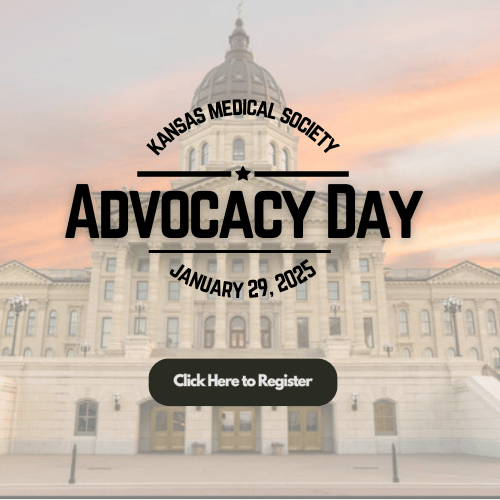
Registration is OPEN for KMS Advocacy Day on Wednesday, January 29, 2025, in Topeka, Kansas!
Kansas Medical Society’s Advocacy Day offers a unique opportunity to connect directly with your legislative leaders. You will join physicians from across the state, regardless of specialty to ask the hard questions that impact the house of medicine. Please plan to meet with your specialty society, KMS leadership & your peers to inform lawmakers, guide decision-making, and generate support for policies on critical issues that impact physicians, patients, and the healthcare environment for our great state of Kansas. Whether you view advocacy as a responsibility or an option, your community participation, leadership, and collective voices are essential to the House of Medicine’s continued leadership in health care.
January 26, 2025 Newsletter
The Kansas Legislature convened for the 2025 Regular legislative session on Monday, January 13th. Leaders have announced a twelve-week legislative calendar with final adjournment in early April. While the first week was largely dominated by the swearing-in of all House and Senate members and other procedural events, committees were in full swing by week two with hearings and bill introductions vying for priority in the shortened timeline.
Of note for Kansas physicians are the perennial bids for increased scope of practice by non-physicians. SB 67 establishing independent practice for certified registered nurse anesthetists was introduced late last week with language that is nearly identical to bills sought in 2023 and 2024. Under the proposal, CRNAs would be allowed “full practice authority,” only prohibiting surgery to place a medical reservoir and perform or prescribing for an abortion. As written, the bill would not further limit CRNA practice or distinguish it from the practice of medicine in any other way. The Board of Nursing would continue to license and regulate CRNAs. The Kansas Medical Society has strongly opposed this legislation since its original introduction in 2023. Proponents have stated they want the same statutory authority as APRNs who were successful in their push for prescribing authority and the ability to order durable medical equipment. However, SB 67 is far broader and essentially equates independent “full practice authority” with the unlimited and independent practice of medicine.
Optometrists are also seeking an expanded scope and have signaled their intent to re-introduce language that would allow them authority to perform certain surgical and other procedures with additional training. The optometry bill failed to make it out of committee last year, but optometrists have redoubled their efforts this year and, in the Capitol, meeting with legislators daily to push for action on the issue this year.
Other bills of interest include SB 41 which was proposed at the recommendation of the Health Care Stabilization Fund Oversight Committee. The bill would add APRNs to the Fund, requiring all nurse practitioners to comply with the mandatory insurance provisions and purchase a minimum of $ 1 million in coverage as a condition of licensure, as physicians, CRNAs, physician assistants, and other participating providers do.
Finally, both House and Senate leaders have indicated strong support for advancing legislation to ban certain procedures and treatments around gender-affirming care for minors. Identical bills were introduced in the House and Senate health committees (SB 63 and HB 2071) which prohibit healthcare providers from treating gender dysphoria with the intent of altering a minor child’s physical sex. The bills provide that a physician performing such services to minors will lose their license, and the legislation creates a new private (civil) cause of action against physicians for providing such care. The addition of new civil causes of action is a growing trend around the country and has been added to several ideological bills as a harsh deterrent. The Kansas Medical Society does not support creating new private causes of action against physicians in addition to and outside of malpractice. Both the House and Senate have scheduled hearings on this issue next Tuesday, January 28th, and have indicated the bill will be among the very first policy debates before each body, with passage very likely.
KMS does not advocate for or against those social or ideological issues predominantly characterized by a conflict or clash of deeply held personal beliefs, values, or principles.
By the end of this month, the legislature will be a quarter of the way through its planned schedule, leaving very little time for additional bills to move through the full process without strong support in both chambers. Nonetheless, your team is at the Statehouse every day to monitor emerging issues and advocate on behalf of you, your practice, and your patients.
If you’d like to learn more about the legislative process, I urge you to register today for our annual Advocacy Day this coming Wednesday, January 29. It’s a great opportunity to meet with your legislators and colleagues of all specialties from around the state to discuss current legislative issues. We’ve had a tremendous registration response once again but would love to have you join us. Registration information is below.
Last day to register for KMS Advocacy Day is Monday, January 27 by 5 PM. Advocacy day is on Wednesday, January 29, 2025, in Topeka, Kansas!
Kansas Medical Society’s Advocacy Day offers a unique opportunity to connect directly with your legislative leaders. You will join physicians from across the state, regardless of specialty to ask the hard questions that impact the house of medicine. Please plan to meet with your specialty society, KMS leadership & your peers to inform lawmakers, guide decision-making, and generate support for policies on critical issues that impact physicians, patients, and the healthcare environment for our great state of Kansas. Whether you view advocacy as a responsibility or an option, your community participation, leadership, and collective voices are essential to the House of Medicine’s continued leadership in health care.